Navigation
- About
- FAQ
- Disclaimer
- Blog
- Contact

Block ‘B’ on the trade exam makes up 19 questions of the total exam and covers Power distribution and generating systems.
COVERED IN THIS MODULE
The code defines high voltage as any voltage exceeding 750V. Refer to Section 0 “Voltage”.
ELECTRIC POWER DISTRIBUTION SYSTEMS
Transmission of 3 phase power from the power plant to the end customer is done over long distance transmission lines. Before leaving the powerplant the generator voltage is stepped up via a step-up power transformer (main output transformer), then stepped down via step-down transformers (substations) before reaching the end customer for use, this is done for a couple reasons:
TRANSFORMER OIL SAMPLING
Transformers that use oil as a means of cooling and insulation (large power transformers) should have oil samples taken at regular intervals.
Oil sampling is a good indicator of overall condition of the power transformer. Taking regular oil samples and sending them to be analyzed in a lab and monitoring the trend of the results can provide advanced warning of problems such as worn, damaged, defective and hazardous components.
When taking an oil sample be sure not to contaminate the sample with dirt, dust or any foreign material and ensure you get a good sample of the circulating oil by flushing some oil first.
If an oil filled transformer has pink silicone on the breather vent this indicates oil venting.
OVERHEAD CONDUCTORS/INSULATORS
Overhead conductors that are used in High Voltage electric power transmission are bare conductors and rely on the insulating properties of the surrounding air.
Insulators are necessary where bare conductors are supported by utility poles and transmission towers etc.
STORED ENERGY
Transmission lines have capacitor characteristics. A capacitor by definition is 2 plates separated by a dielectric. In the case of transmission lines, the two plates are the transmission line conductors and the dielectric is air.
HIGH VOLTAGE EQUIPMENT INSPECTION
Thermal imaging cameras can be used to identify problematic areas (hot spots) on high voltage equipment. A sensory inspection can also be done looking for corrosion, loose components and discolouration of high voltage equipment and its parts.
CORONA
Is the breakdown of air as an insulator. It is a condition where the air becomes ionized, When the air is ionized heat and ozone are produced,this condition causes high voltage insulation to break down.
HIGH VOLTAGE TESTERS / GROUND SETS
High voltage testers are used on high voltage electrical systems to ensure that the system you want to work on has zero potential.
Ground sets are used to drain (de-energize) capacitance charges, induced voltages on transmission lines and protect the worker from inadvertent energization during maintenance activities.
STEP AND TOUCH POTENTIAL
2015 CEC 36-002.
When in areas of high voltage, step and touch potential must be considered:
Step potential: The potential difference between two points on the earth’s surface separated by a distance of one pace, assumed to be 1 m in the direction of maximum voltage gradient.
Touch potential: The potential difference between a grounded metal structure and a point on the earth’s surface separated by a distance equal to normal maximum horizontal reach.
Low voltage power distribution systems can be single phase or 3 phase systems. Low voltage power distribution systems provide power to the plant via power transformers, distribution panels, MCC’S and electrical disconnects etc.
The code defines low voltage as any voltage exceeding 30v but not exceeding 750v. Refer to Section 0 “Voltage”.
SINGLE PHASE AC
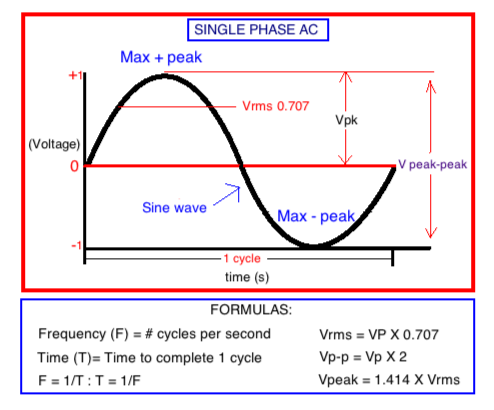
RMS VALUES (Vrms)
PHASE RELATIONSHIP BETWEEN VOLTAGE/CURRENT IN AC CIRCUITS
To remember these phase relationships between voltage and current in ac circuits remember the saying “ELI the ICE man” refer to the diagram below.

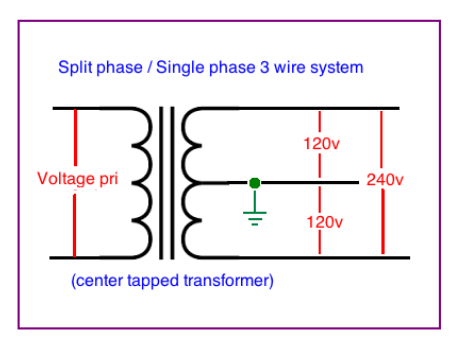
SPLIT PHASE/ SINGLE PHASE 3 WIRE
With this configuration 120v/240 can be supplied to a home via a split phase, single phase 3 wire system as shown below.
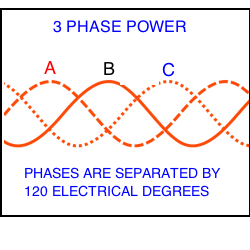
3 phase power provides 3 alternating currents that are 120 degrees out of phase with each other. 3 phase power can be thought of as a combination of 3 single phase circuits that provides constant power to a load. 3 phase power is typically used in industrial and commercial establishments where there are many inductive loads (motors).
There are clear benefits to using 3 phase power over single phase power, these are:
MOTOR CONTROL CENTRES (MCC)
MCC’s are groupings of starters (circuit breaker / overloads, fuses) typically used for motors but not only limited to motor control that are grouped together in one manufactured assembly and having a common bus supplying power to individual cells. Motor control centres are widely used in industrial plants.
Each cell typically contains: Circuit breaker, motor overload/fuses, motor contactors, control transformer and associated wiring. MCC cells may be used by maintenance personnel to apply their lockout and tagout to ensure safe work.
Switchgear should be clean, dry and connections tight. Loose connections may show signs of excessive heat (discolouration) due to high resistance and may also cause false tripping. Loose connections is one major source of electrical faults. Thermal imaging cameras can be used to identify problem areas such as hot spots on MCC’s.
ARC FLASH HAZARDS
Arc flash is a rapid release of energy due to an arc fault between phase to ground and/or phase to phase . Arc flash ionizes the air around the fault (air becomes conductive) and can produce an arc blast that consists of extreme amount of light, heat, molten metal, noise and pressure wave. The severity of an arc flash is determined by the amount of time needed to clear the fault (usually in cycles). Arc flash hazards and arc flash PPE should be considered before working on any piece of electrical equipment.
PHASING FOR 3 PHASE ROTATING EQUIPMENT (motors)
When connecting a 3 Φ motor the supply must be connected to the motor leads correctly to ensure desired rotation.
Before installing a repaired or newly purchased motor and motor phasing is unknown, use a phase rotation meter to determine the proper phasing (A,B,C) of the motor.
REVERSING THE ROTATION OF A 3 PHASE MOTOR:
To reverse the rotation of a 3Φ motor, interchange any 2 leads.

